Showing posts with label Professional Standards. Show all posts

Monday, 23 July 2012

Developing my Practice and Staying Sharp!

We're running a series of guest post on "Positive Practices in Coaching & Mentoring". You can read last week's excellent blogs from Clare Manning here & Ian Pettigrew here.

Today's post is brought to you by Julie Drybrough (@Fuchsia_Blue). As a consultant, facilitator and coach/mentor Julie has worked extensively in both private and public sector enterprises across the UK & Channel Islands for over 12 years. She specialises in leading and supporting organisational & people development, always striving to translate the learning intentions of the organisation into practical actions and outcomes.

I hope you enjoy her post!


Developing my Practice and Staying Sharp!

Reading Clare Manning’s post on Magnificence in Coaching this morning has left me inspired. I’m drawn to the notion of seeing magnificence in my clients – I always see them as resourceful, smart, capable, working hard through their stuff… but magnificence is special and I’m going to work to keep the concept of Magnificence in the room next session…. Fabulous.

Since David asked for guest blogs on Positive Practice in Coaching & Mentoring, I’ve been mulling on what my offering might be. What has emerged is a cross between my history as a developing coach and a call to supervision and support for all practitioners. It goes like this:

I came through the ILM 5 school of coaching – learning my craft through very practical advice about setting up the coaching contract, the process of coaching, some brilliant models and an encouragement to practice, journal, reflect.

For a long time, I stuck to the processes – using GROW and working with the client to identify goals and work through barriers. My reflection on this now is I was working a lot from my head at the start; being analytical of the client’s situation and language; remaining somewhat cool and detached from the person in front of me (check me: Professional Coach!) We had a hour and goals to pursue. Let’s go. From feedback, it was a broadly successful way to work with the client to unlock and unblock. I got repeat business, got recommended on. So it was OK.

Yet I had little scratchy voice telling me there was more for me and for my clients, somehow. I often had more “real” conversations with the client as we opened up or closed off a session. I felt more comfortable when I wasn’t worrying about whether or not we had explored Reality well enough… I felt a little stifled sometimes. This made me curious, so I sought Supervision.

As a person, I’m wired to be intuitive. I’m pretty in touch with my heart voice and my gut voice and I realised, through joining a peer Supervision group, that I wasn’t bringing my whole self to work. My original clients got Head-me……Clients now get whole me. My sense is that works a lot better for everyone.

My coaching practice is increasing grounded in Gestalt methodologies; working to pay exquisite attention to the person opposite, listening well, watching their responses and mannerisms. Part of the deal is I also use my own body, thoughts and responses as data for the client – co-creating a learning, exploring environment where I can reflect back that I feel stuck, or delighted, or that “I’m noticing a clenching of fingers when ever the new “lovely” boss is being mentioned….might that be significant? “

I work hard to stay curious about what I hear, see and experience. I am sometimes off-beam when I offer a reaction and I see my job then as being to explore more with my client. I am not the expert. I have expertise, sure, but only my client (in all their magnificence) truly knows what is real for them. I offer what is real for me and more often than not it is good grounds for discussion. These days I find we don’t just set and pursue goals, we redefine goals. How cool is that?

I’m mindful that I’ve written a lot here and I really could say a lot more….but a key point to all of this is what has consistently helped me and moved me forward as a coach and practitioner has been seeking out supervision, support…whatever you want to define it as.

I’ve had some 1-2-1 Supervision, I’ve worked in an informal peer “triad” in Edinburgh (which was amazing) and I am now in a more formal Group Supervision set with 5 other peers.

As coaches, I would say some of the most positive practice we could participate in is to ensure we are OK. OK as individuals. OK as people. I’d ask us to be rigorous and reflective about our practices; to stay open to new learning – to allow ourselves to bathe in our own magnificence, perhaps.

There are debates raging about Supervision and what is right and proper and accredited – I’m not getting into any of that. I focus on my need to stay sharp for my clients and notice when I’m in difficulty. I seek out peers and non-involved professionals to support me and that feels good. It’s part of my values and my practice. I go with what works. For me, it has been about addressing different needs at different times.

So my offer of positive practice to all magnificent coaches out there is pretty basic: look after yourselves first and you are ultimately looking after your clients well.

Wednesday, 13 June 2012

At risk of being coached?

I met someone earlier this week and we were talking about coaching. The conversation turned towards how some practitioners take a very purist stance towards coaching and how others don’t. 

In this instance, a purist stance would be what is often termed “non-directive”. That is to say that the coaches role is purely to ask open questions without directing the client, using the clients own language... The main principle is that the coach does not in any way provide advice or direct the clients actions. 

To be pedantic there is no such thing as “non-directive” in any human interaction but that’s another blog! 


Whose Risk? 

I’m not knocking the spirit or the practice of “non-directive” coaching. However, this isn’t always what a client wants. In an organisational setting it’s not always what a client needs. So who decides? 

Take for example a manager who is having trouble performance managing members of staff. The purpose of the coaching & the contracting with the coach is focussed on improving the managers ability to deal with performance situations. 

In the coaching conversation, the manager decides to take a course of action that to an informed outsider would clearly put them & their organisation at risk – say unfair dismissal. 

If the “non-directive” coach, identified the risk how could they intervene and remain “non-directive”? It’s a perfectly reasonable & professional practice in any form of coaching (or mentoring) to seek permission to “take off the coaching hat” to offer thoughts or reactions. However, for a purist coach to do this in some way would seem to undermine the whole purpose of being “non-directive”. 

Here’s another perhaps more important issue. What would happen if the “non-directive” coach didn’t appreciate the risk being taken. After all this is not what they were employed to do. Could they become complicit with reinforcing the clients’ agenda and decision to take a detrimental course of action? 

Who decides what a clients wants and what a client needs? Whose risk is it? 


The ill advised need sound advice 

Coaching is not about giving advice. However, it is about care for our clients. 

Fundamentally, no amount of “non-directive” coaching will help the ill advised follow a safer course of action. In fact, the above example shows that “non-directive” coaching may even enforce their stance. 

In any other walk of life, it’s hard to imagine a paid professional sitting across from their client and letting them pursue a course of action that would put them at peril without raising their own concerns. 

Perhaps this is why organisations tend to “buy” coaches with industry & leadership experience rather than purely coaching qualifications. 


Does purist coaching make sense in organisations? 

I can’t say never, but I have a long standing concern...

Even though we always strive to help our client determine their own agenda and actions, coaching is a human interaction. Human interactions require us to give of each other and see each other - @Projectlibero puts this very eloquently here.

In organisations, we are working in systems where potential risks and consequences of our actions can be amplified. If we don’t share our care and concerns do we potentially put our clients at risk? 

What do you think?

Tuesday, 22 May 2012

Communities Take Action

I’m just returning from latest Coaching & Mentoring “research day” run by Sheffield Hallam Business School (SHU). For those of you who don’t know, the round trip to Sheffield from my home in Norfolk is over 7 hours by train. Not something I undertake lightly but these “research days” are worth every minute!

The train journeys also give me time to work & blog... 

The value of the Unconference format 
Run with an OpenSpace format by the Coaching & Mentoring faculty at SHU these “research days” might also be described as quarterly unconferences.

I’m a big fan of the unconference format but I believe there’s always a risk that they won’t produce any tangible community action. There may be lots of great individual learning, connecting and discussion but leading to what? 

Assuaging my unconference fears was last months’ first #LDConnect Unconference (#ldcu). This has generated some great thinking which has continued and developed after the event and is in my opinion building towards real action. 

Today’s “research day” went one further. 

Community Action 
In one session, a very lively group of us explored the dynamics around Coach Supervision and the expanding number of coaches becoming Coach Supervisors. 

On the one hand there was appreciation for the role of Supervision as part of our development & professional practice. On the other hand, the rapid growth of income generating Supervision with a focus on coaches and not mentors felt like a big warning signal. 

After some great discussion a vision for the future was loosely developed. I won’t go into too much detail here & now as it’s going to be developed into a co-created article for the Industry magazine “Coaching at Work”... 

A positioning paper from a group of professional coaches/mentors & academics to challenge the status quo. To share our collective thinking on how the industry could adopt a more suitable approach to developing professional practice. 

Now that is what I call action! 

Simply Special
Was this group special? Yes and no...

We developed this thinking collectively around an area of common interest. We saw something wasn’t quite right but we were keen to develop our understanding through open dialogue. We came to a joint conclusion on what could be done to constructively (not destructively) create a better future. We decided to take action - collectively. 

It was that simple and for that it is also a bit special. 

What you going to do?
I know we’ve not completed our journey yet. We’ve not yet shifted the thinking of the industry let alone the professional bodies. But we’re going to try in a constructive & collaborative manner. 

We could all do similar - something simple, something special.

So why don’t we just do it?

Friday, 30 March 2012

Who complains about Professional Conduct?

Earlier this week I picked up on a few tweets about the @CIPD revised Code of Conduct. There's also a good article (& comment) over on People Management. You may have seen some of the exchanges on Twitter between myself and @FlipChartRick, @MJCarty and @RobertBlevin. For a mini case study touching on the subject you might appreciate this post from @FlipChartRick - "The BNP HR Manager". 

Me & the EMCC 
As a member of the EMCC I readily abide by their Code of Ethics - it's a standard that is important to me personally and as a professional. It's supported by a Complaints Procedure that can be used to investigate complaints of professional misconduct by EMCC members. 

I believe these are both important underpinnings for a professional body like the EMCC. It's sets expectations and helps protect standards for both the profession as well as clients themselves. Yet in all my encounters with fellow EMCC members, I've always felt that they joined because they hold these standards dear. They are in my eyes the least likely to deliberately breach the Code of Ethics. 

Enforcing Standards 
By it's very nature, the membership and exposure to the HR agenda is much greater for the CIPD than the EMCC. However, I was surprised when @FlipChartRick asked on Twitter "How often are people chucked out of the CIPD and what for?" and @CIPD responded "Rarely, but has happened in case of serious breaches - typically where law’s been broken". 

I'm very supportive of both the wording and the intent of the CIPDs Code of Conduct.  However, I wonder what this revised Code of Conduct heralds? 

The Case for Standards 
Codes of Conduct & Professional Standards supported by an appropriate and diligent Complaints Procedure make perfect sense. Why wouldn't you have them if you were serious about standards of practice? 

These don't have to brought into play only when there is a breach of the law. For me this is a sign of a professional body who cares about the practice of the profession rather than protecting its membership. 

The Conundrum 
I think there is a conundrum here especially with regards to complaints...

Members are likely to work within the Codes of Conduct as a matter of course. Those members who don't are not likely to complain about themselves. Do fellow members feel inclined to complain about each other? 

Non-members be it individuals or organisations are most likely unaware of any Code of Conduct. Effort can be made to make non-members aware of what Conduct is expected of members but few organisations actively go out of their way to seek & encourage complaints. So who will complain? 

Perhaps this is why historically CIPD has not seen many cases of expulsion due to serious breaches... 

What do you think?
Do Codes of Conduct really make a difference to standards? I think they do if you are personally inclined to maintain appropriate professional standards. They act to guide your practice. 

Do they encourage legitimate complaints to be made to deal with transgressors? If not then how do professions seek out and deal with poor practices?  What do you think?

Friday, 10 February 2012

Friday Wondering - What is Coaching & Mentoring?


Each Friday I'm posting a "Friday Wondering". These posts are meant to explore & discuss observations or issues which I think would benefit from discussion. Participation is open to absolutely anyone regardless of their expertise or knowledge. Just bring your curiosity!

If you'd like to discuss on Twitter rather than here then why not. It would help though if you could use the #FridayWondering hashtag. Thanks!


What is Coaching & Mentoring?

As part of International Coaching Week, I’ve accepted a challenge from @StirTheSource to deal with the question of “what is or isn’t coaching & mentoring?”. Sounds simple doesn’t it? Textbook stuff... 

Actually, that’s the challenge. Hundreds of books have been written about coaching & mentoring by academics, trainers, practitioners & consultants. For all that intellectual resource there is no apparent definitive answer, not even if you look to the professional bodies. 

The Definition Dilemma 
So why is there no definitive answer? Let’s start with the obvious. There is no overarching professional body for either coaching or mentoring as there is with say Accountancy. 

In the absence of an overarching professional body a variety of similar definitions can co-exist. 

For all the historical references to Coaching (Pendennis) & Mentoring (Homer - not the Simpsons!), the question of definition seems only to have become important in recent years with the advent of coaching & mentoring in organisations or as a service. Clients want providers to explain their solutions. Authors want to assert their views. Professional bodies want to set standards and expectations. 

The commercial market demands explanation but not a single definition. 

I think there is also another commercial (or perhaps human) interest at play here which is the need to differentiate from other practices. Coaches, as an example, are generally quick to point out that coaching is most definitely not consulting, mediation, training, therapy, counselling or even mentoring! 

There is perceived advantage to describing coaching & mentoring in a way that differentiates. 

I believe that the above dynamics have contributed to a crowded and extremely varied UK market to the extent that coaching as an example has a bad reputation for some. 

So with the above in mind there I have a dilemma about how do I answer the question of “what is or isn’t coaching & mentoring”? To answer provides another perspective and reinforces the above status quo which may not be seen as helpful. To not answer would seem to say that I don’t know how I practice coaching & mentoring! 

What coaching & mentoring is & is not 
As I’ve already mentioned, coaching is not consulting, mediation, therapy, counselling or even mentoring. The most effective way I’ve ever seen anyone describe this comes from @SandroDaSilva who wrote “A butterfly goes to a coach”. Do take a look over on his blog if you’ve not read it already. 

To add to this, I do not believe coaching is just about asking questions. Some people do. For me a human interaction that connects with you requires more than just asking questions. Feedback, observation, reflection are all valuable tools that we can share with our clients to support them. It’s worth also referring to my recent post on “Advice in Coaching”. 


The Confessional 

Personally, I don’t believe that there needs to be a single definition of either coaching or mentoring. 

I believe that coaching & mentoring have a variety of similar but differing definitions because they describe relationships based on deep levels of trust. Without such levels of trust I don’t believe coaching & mentoring can be successful. We all see such relationships through our own eyes, experiences & emotions hence the diversity of similar definitions. 

I value the diversity that exists and I think clients do also - they want a variety of solutions that create long lasting sustainable change. However, we should be more definitive regarding poor practice - I think that’s a whole different blog! 


I've said plenty!  What are your thoughts on coaching & mentoring?

Thursday, 9 February 2012

Advice in coaching

Traditional wisdom in coaching suggests that advice giving is poor practice. The rationale is that by giving advice to a client you are leading or telling the client what to do. 

This directive action introduces a form of judgement and potentially takes away the clients’ ability to create their own solutions. In its purest sense this can have a consequence in terms of the coaching relationship and even limit the impact of the coaching. 

However, it’s often raised as a debating point in coaching circles, even by experienced practitioners. Is advice giving really poor practice? 

My view 
I believe that no matter how you practice as a coach, it is always to serve the interests of the client not yourself. If this care is absent then you are not coaching. 

There are a broad range of coaches, coaching practices & client needs out there. I think the question of advice in coaching is more an issue of how can advice help or hinder a client during a coaching session. 

From this perspective, in terms of advice giving, I think it’s helpful as a coach to be conscious of  two simple calibrating questions first: 

What form could the “advice” take? 

Be clear about what form the “advice” could take and how it might be received - feedback, observation, information, recommendation, obligation, expectation, judgement, critique, criticism. 

Who would giving advice truly serve? 

Connected to how it might be received, assess who does this input really serve? What are your motivations? What could the consequences be? Will it help shift thinking or action? Do you have an obligation to provide this input? Do you need to do it now? Are you the best person to provide this input? What will happen if you don't do it now? 

Using these two calibrating questions I find that I don't have to worry about the word "advice". I can focus my attention on how can I best care for the client at that moment in time. 

As it happens I almost never find myself feeling the need to give advice whilst coaching. When it does happen, I’m able to recognise it and if appropriate, offer it the client as it is meant, even “pausing” the coaching session if necessary.  Above all, this process ensures that the client can retain autonomy & self-determination in the coaching process.

What do you think about advice in coaching?  How do you deal with it in your practice?

Wednesday, 23 November 2011

Twitterethics


Perusing the “Activity” function last night on Twitter, I noticed that someone I was following had just followed what is best described as a porn tweet account.  I didn’t even know they existed!

Anyway, I don’t know this person but I’m interested in their business.  They are the founder/CEO of a major people change organisation which relates closely to my own work.  Seeing that they actually use Twitter and that we have networks in common we ended up following each other.

Ethics in the moment
What happened next was spontaneous.  I unfollowed them.

Immediately after I found myself questioning whether I was being prudish.  Did it actually matter if this person, like many others, liked pornography?  I’ve not felt the need to unfollow anyone because of an ethical issue.  Yet this felt like one.

On reflection, I’m surprised at their stupidity of publicly following a porn tweet account.  I don’t see a place for this in business or professional circles and I don’t believe such actions build the right type of engagement.  Personally, I don’t want to be associated with people on Twitter who do.

Looking at their client list I think they are playing with fire.  It’s the kind of action that can lose you business with clients who care about their reputation & associations.

A learning experience!
I have my own ethical standards and values but I don’t force these upon others.  I think I’m very much a live and let live kind of person.  This just felt wrong to me.

Yet I have to say I’ve never experienced Twitterethics before.  So I want to share my actions & thoughts for your scrutiny!

What are your thoughts?
What would you have done?
What ethical dilemmas have you faced on Social Media?

Would love to hear from you!

Monday, 21 November 2011

Ruthlessly Results-Oriented


What ideas or reactions does the word RUTHLESS concoct for you?  It probably evokes feelings of someone who would trample over you or others to achieve their goal.

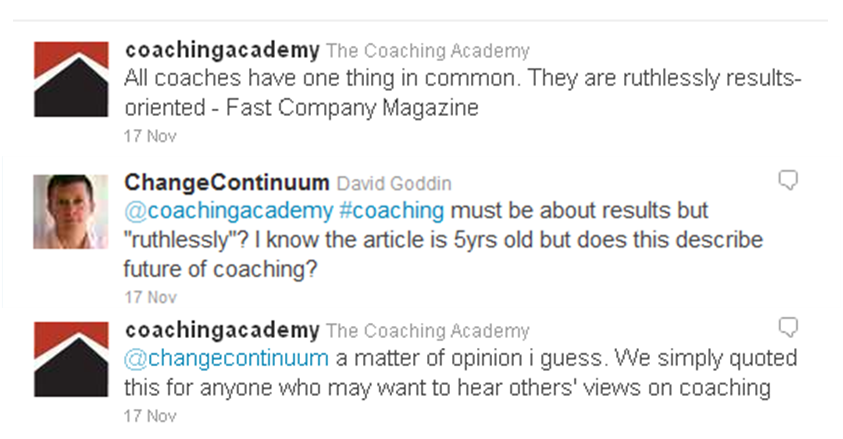
So what if I described to you someone who was "ruthlessly results-oriented"?  I recently exchanged tweets with @coachingacademy as follows:
A bit more research and I found the referenced Fast Company article “Wanna be a player?  Get a coach!” written by Claire Tristram in 2006.  The actual passage in the article states:

“If coaches have one thing in common, it's that they are ruthlessly results-oriented”.

I disagree.  Completely.

A question of Trust
In coaching, the basis of a successful coaching relationship is trust.  With trust established, a skilled coach can create the right degrees of tension and challenge to raise awareness and help facilitate change.  Without change there are no meaningful results.  Without results, coaching has no value.  Results come from trust.

This perhaps defines what good coaches have in common.

Ruthless means to act in a manner which is cruel, merciless or hard-hearted, without pity or compassion.

To me this feels like the antithesis of good coaching.  It feels like it could undermine trust.  It feels like it could drive a client to follow the coaches agenda, not the clients own.

A problem from the past
The article was written 5 years ago and is after all just one article.  There is an increasingly better understanding of coaching and what good practice looks like, especially when working with Executives.  We’ve moved on right?  Well this is where I have the problem…

Try Googling "ruthlessly results-oriented” and you initially get 8,330 results!  Scroll through them and it comes down to 259 results.  Over 40% of these are postings from the last year all of which seem to reference and endorse this phrase used in Fast Company magazine 5 years ago.

So what I take from this is that there are plenty of people out there who still feel that “If coaches have one thing in common, it's that they are ruthlessly results-oriented”.  Most of these people seem to be coaches…

Does it matter?
Those who know me well enough know that I’m passionate about assuring quality practice in both coaching and mentoring.  It’s one of the reasons I’m involved as a volunteer with the EMCC.

The basis for coaching is trust.  The value of coaching is in the results we help our clients achieve.

My concern is not with an article written 5 years ago.  My concern is with the continued use of language which harks back to an era when some coaches were more interested in their own results rather than their clients.  This worries me.  Deeply.

So that's my view but how about you?  Tell me what you think...

  • How would you feel about a coach who was “ruthlessly results-oriented”?
  • What are your concerns about poor coaching practice?