Friday, 9 December 2011

A Model for the Weekend!

I've been thinking about the relationship between competence, expertise & mastery which has recently been renewed by a blog post from @naturalgrump here.

What I've noticed is that much of the time our expertise comes out subconsciously but when this happens there is a confidence to our actions that is recognised by others if not ourselves. At other times our expertise is more explicit and understood and again combined with confidence it is recognised. I'm curious about the role confidence plays here so have drafted a model to explore this further.

The Model
What this tries to show is some of the observation above but more explicitly how the relationship between feelings of confidence and our actual expertise & knowledge manifests itself.
As I explored the relationship, I perceived a "zone" where we are in essence incompetent. With low confidence we are just INEPT. With high confidence we become DANGEROUS. I'm sure we can all think of examples but car driving is something that sticks in my mind.

However, there comes a stage where you move from incompetent to competent. In essence, confidence doesn't change the fact that you are competent. I've called this PERCEIVED COMPETENCE. This may be perceived by yourself or others. With increasing knowledge & expertise we attain PERCEIVED EXPERTISE and in my mind this ultimately leads to MASTERY. I think the principles are straightforward enough but something funny happens when you throw confidence into the mix...

I've come across many examples where the combination of enough competence and high confidence can very quickly move you from PERCEIVED COMPETENCE into PERCEIVED EXPERTISE. I don't think there's anything wrong in this necessarily but perhaps you now see why I've been using the word "perceived"!

With regards to MASTERY, I don't think it behaves this way. In fact, without the confidence underpinned by actual knowledge & expertise you can not attain MASTERY. The reality is that very expert people with high knowledge won't achieve MASTERY without high confidence.

Conscious Competence Model
As you've read through this you might have started to think about the conscious competence model. I think there's some relation here but it doesn't fully explain the impact of our confidence.

When we act with unconscious incompetence we can assume that our confidence is higher perhaps than thereafter when we know we are incompetent. We can also assume our confidence may increase with competence. This may not be the case though if we don't feel confident. Also, what is the relationship between unconscious competence & expertise or even mastery?

Below is my interpretation of the overlay but perhaps this can be viewed differently.

What Next?
This is purely exploration at this stage but it's helping me think about my own professional development. Perhaps it has an application in a client context.

What would be great is if you could provide your views or thinking on this. Nothing is sacrosanct and I'm happy to be told I'm wrong or that this is old hat!

So what do you think about the above?
What are your thoughts in general about how we attain expertise & mastery?
What role does confidence play in how we our competence is perceived?

Wednesday, 7 December 2011

Cliqmunities

Some things make you react. @naturalgrump recently wrote about this here. Before you read any further please do take a read through his post above as it’s very relevant for what comes next!

A Twitter Reaction
This morning’s twitter stream soon filled with the CIPD 2011 Social Media conference
.  I’d forgotten exactly what was on the agenda so I skipped over to the CIPD website for a look.  Looking at the details, what I hadn’t appreciated was the price....  tickets were £550 for members or £600 for non-members.

I’m a pretty tolerant soul and being typically Libran I’m usually quite good at seeing both sides of an argument.  However, the old amygdala kicked in big time when I saw the price.  Now to be clear, this is not a case of amygdala hijack!  However, for some reason, this is making me react...

Is this some reaction to the CIPD?  
No – I’m not anti-CIPD.  In fact their embracing of social media and engagement with the community seems to be a positive thing.

Is this jealousy?  Do I wish I was there?
No – I already made the decision about what was most important and existing diary commitments won.  I can catch up on what I missed through social media and friends.

Is the scheduled agenda the issue?
No - I have no particular views on it but knowing who’s involved I’m sure it will be excellent.

Deja Vu
The above don’t seem to hold any answers but my sense is that my reaction was in some way connected to recent blogs on conferences:

@onatrainagain wrote here about the prohibitive cost of conference attendance for certain sectors or those with restricted financial circumstances.

@robjones_tring wrote in quite a different vein about the conference experience here.   In fact I think he was talking about revolutionising the conference experience.

@neilmorrison also wrote here about conference attendance and value, remarking that something is going to have to change...

What is really going on here?
Well I think possibly a few things but they centre about these observations...
  1. The cost of the conference today is prohibitive for some if not many.  I understand the argument about affordability being our own judgement.  However, in such times, when we price events at such levels we are effectively excluding people.
  2. In the past year I’ve attended conferences, unconferences, events and research days.  The ones that have created the most value for me are those where there is content, challenge and community in abundance.  Not exclusivity.
  3. There seems to be a correlation between community value and price paid.  Where community engagement is high and is the driving force, the value is high and the cost is always low.
I value inclusivity and believe in the value of communities.  My concern is that if we ignore the above we will find ourselves creating "cliqmunities"...

What next?

I’ve tried to be non-judgemental but please do react.  Tell me what you think.  Shape the thinking around this subject.

Talk about the impact of today’s conference in the context of the above.

Talk about the value of the mainstream conference format.

Talk about how community can be brought together without exclusion.

Perhaps more importantly, if you want to help provide low-cost learning or mini-conferences for the broad HR community who can’t afford mainstream prices.  Then say so.   You won’t be alone.

Post Script
The title of this post was inspired by a tweet from @BillBoorman. I’d been struggling to describe and finish this blog and it just seemed to fit. Thanks Bill! 

Tuesday, 6 December 2011

Learning Journeys


Living in Norfolk, I’m well used to commuting by train for work or conferences.  So I’ve found myself in the lucky position of having plenty of time for reading, writing, working & reflecting.  I can’t sleep on trains I’m afraid...

Today I got up at 05:15 and will get back home around 15 hours later.  I’ll have spent over £130 and 7 hours of my day on trains.  I won’t earn a penny  from it.  Why?  To learn of course!

Learning School
The reason for today’s trip was Sheffield Hallam Business Schools Coaching & Mentoring Research day.  Each quarter, they run a 6 hour learning day using Open Space.  It’s a very inclusive affair so look them up if you have an interest.

The wonderful thing I find about Open Space is that it never fails to please or surprise me.  Today was no exception and after wonderfully rich discussions, it’s left me with a few thoughts around coaching & mentoring :

Social Media & Coaching/Mentoring
So, is there any application for coaching or mentoring using social media?  Perhaps but maybe what is more meaningful is what method(s) and frequency of engagement do clients (coachees) find most relevant and supportive?  How is this expectation changing generationally?

E-Mentoring
This segues into the above but if you want to run a mentoring programme, what are you trying to achieve?  It’s easy to develop tools and lose sight...  How can you provide the system & process for groups & communities to engage in a way that is meaningful to them?

Pricing & Value in Coaching & Mentoring
It’s funny how little external coaches & mentors discuss pricing together – what prevents them?  What does it say about the profession?  Beyond that, how do we best demonstrate the value of either as a paid for professional service?

Disclosure in Coaching & Mentoring relationships
You wouldn’t think one little word could mean so much...   What we disclose to our clients has potentially enormous implications on the success or failure of the coaching or mentoring.

These themes give you a sense of the discussions I participated in – there were at least 8 others that I missed.  Over the coming days I’ll try to blog about each individually.

In the meantime, I’d love to hear your thoughts or reactions on these subjects.

On the subject of Learning Journeys, what would you would do with 7 hours of uninterrupted time at a table on a train?

Friday, 2 December 2011

The one where the "Boot" was on the other foot – Part 4 "The Art of Giving"

Last week I was invited to join a demonstration day with TrainersKitbag (@trainerskitbag) and in this week’s series of blogs I’ve talked about my reflections from the day.  In today’s final blog I’d like to share my reflections regarding Generosity.

Part 4 “The Art of Giving”
By Christopher Smart, via Wikimedia Commons
I’m sure none of us are strangers to giving or even being generous.  It’s part of being human… sending gifts on birthdays... helping out with a bit of DIY… taking time to listen to a friend’s problems.  For most of us it’s what we do with our friends & families and it’s rewarding.  We often don’t think about it being an act of generosity.

Even when we look to give our time or money to strangers, say through voluntary support or charitable donations, we still tend not to talk about our acts as being generous.

The meaning of generosity
Perhaps take a moment to reflect on the meaning of gen·er·os·i·ty :
  • Liberality in giving or willingness to give one’s money, time, etc.
  • Nobility of thought or behavior; magnanimity.
  • Free from pettiness in character & mind
  • Amplitude; abundance; plentiful

I’d forgotten the word's Latin origins.  It derives from generōsus, which means "of noble birth".  Originally, being generous was literally a way of complying to nobility.  Over time this origin has been lost but the sentiment hasn’t.  Generosity as an act of giving is still seen by many as an act of humanity.

The generosity of strangers
The nature of the Trainers Kit Bag “Property Trading Game” game requires you to perform tasks.  Sometimes these involve asking strangers for information or help.  Throughout our day we were struck by just how spontaneously people would help us with what were sometimes quite bizarre requests…
  • The gentleman on Pall Mall whom we asked for a business card.  He’d have happily given one to us but he’d just given a man who had had his car clamped £20 for a train fare and had given him his last business card so he could post the money back.  His view was that he wanted to help and he may never see that £20 pound again but that wasn’t really the point.  You had to trust in human nature.  A very genuine and lovely person.
  • The armed policeman dashing out for his lunch break who gladly stopped and posed for a smiling “team photo” before heading into McDonalds for his “fix”.
  • The endless shopkeepers, hotel staff & theatre box offices who took time to listen to our strange requests and helped us where they could.  Yet, we bought nothing from them apart from a 50p “Sights of London” pencil.
  • Perhaps most surprisingly was @RichardAArnold.  Having been spotted walking past us on the Strand, @StirTheSource ran after him and he gladly helped us with our much needed celebrity photo and autograph.  He took time to talk about what we were doing and shared a laugh.  Firstly though he went to the bank, then came back and found us, all on his birthday with a hangover.  That’s generosity!
The Art of Giving
On reflection, it’s perhaps not surprising that a day that started with the generosity of Trainers Kit Bag, continued in that same vein throughout.  Even to the end of the day when someone I’d just met for the first time asked “Is there anything I can do to help you?”.

This post isn’t about how to give or what to give.  It’s more of a recognition that we all give willingly and generously.  Perhaps we need to be asked, nicely of course, but we are all qualified in the art of giving.  If you feel you’ve not practiced this art for a while then have a go – it’s very easy.

“Real generosity toward the future lies in giving all to the present.”
Albert Camus

Thursday, 1 December 2011

The one where the "Boot" was on the other foot – Part 3 "The Way we Act"


Last week I was invited to join a demonstration day with TrainersKitbag (@trainerskitbag) and in yesterdays blog here I talked about my reflections from the day focussing on “The Way we Think”.  In today’s blog I’d like to share my reflections on how we act.
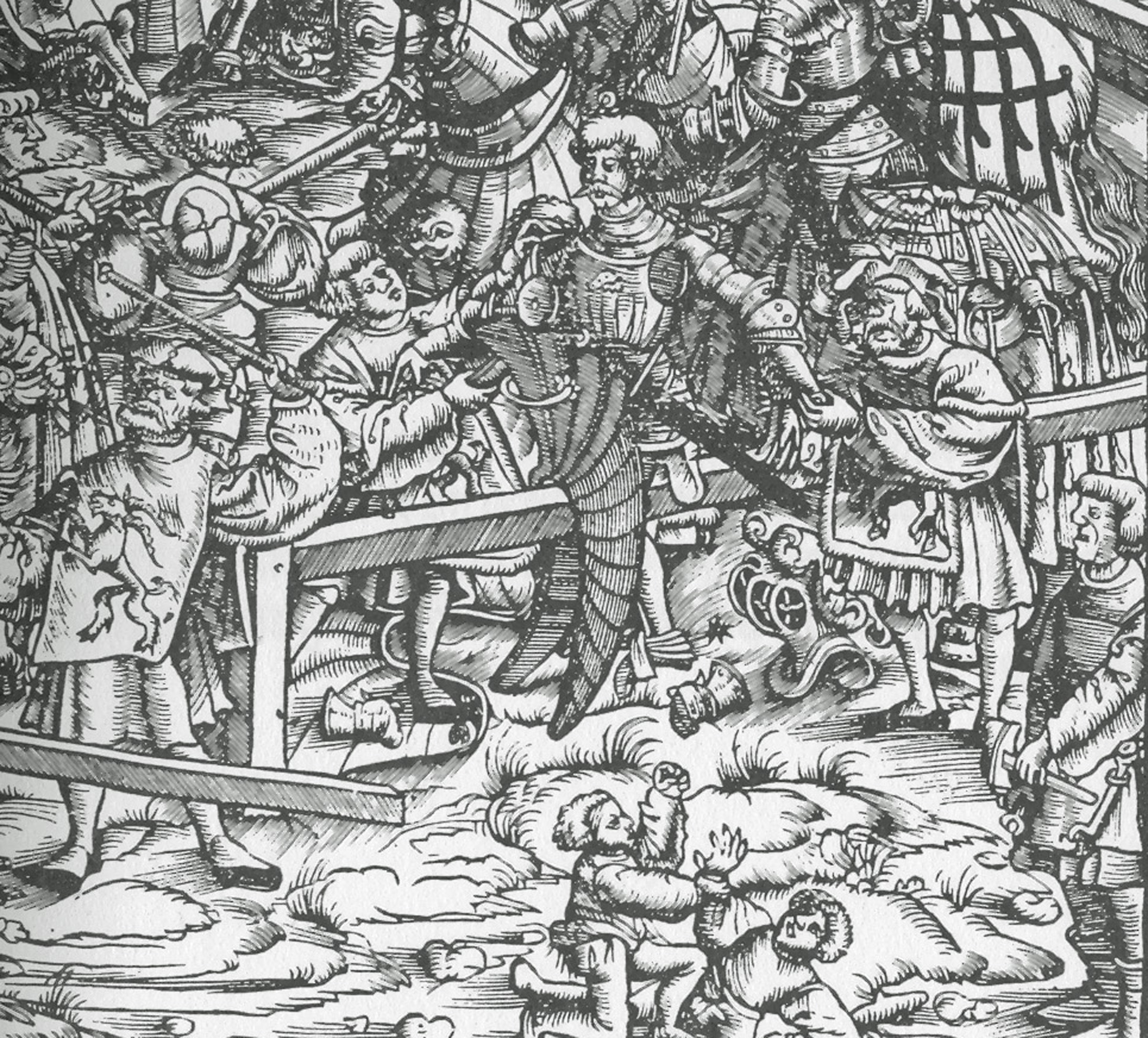
By Herzog Hans, Pfalzgraf, Graf zu Spanheim, via Wikimedia Commons*

Part 3 “The Way we Act”
When put into a situation such as game play we’re often debriefed afterwards about how the players could have acted more successfully.  Sometimes it’s simple task oriented things:
  • At the very start, take 15 minutes to discuss/agree a strategy.
  • Make sure you assign roles or a leader.
  • Periodically take a moment to review your plans & actions.

Sometimes it’s a little more complex as we look at behaviours and interactions:
  • Be aware of the team dynamics.
  • Take time to understand the personality types in the group.
  • Use a range of communications styles to bring across your point.

All of these have merit and the great value of the facilitator/coach in such team situations is that they can independently observe your actions & behaviours.  With trust the facilitator/coach can create the right degrees of tension and challenge to raise awareness and help facilitate change.

The way we can act with skill
On the demo day, you’d think that our team of seasoned professionals shared & followed the best practice that we know & love.  Well not exactly…by and large we just got stuck in!

We knew that developing a strategy for the game at the start was an appropriate thing to do but we chose to take action first and then strategise on our way.  We didn’t assign roles at all.  We reviewed our actions constantly.  We were still very successful in our tasks.

So what was going on that allowed us to apparently ignore the textbook rules?  Well I think two things:
  1. We were already familiar and practised at working in such team environments.  I wouldn’t say we were masters (read here) as such but we were able to trust our intuition (read here) and break some of the "rules".
  2. We had a number of enabling factors working in our favour (read here) which when combined with our experience created successful behaviours.

In hindsight, where I think we could have improved was in terms of a deeper strategy conversation around 20 minutes into the exercise.  This wouldn’t have changed our next actions but it may have helped relieve some of the effort we had to make towards the end of the day.

On reflection I think my message here is to pay attention to best practice.  However, if you are practiced and able to employ successful behaviours then go with your intuition.  Feel free to break some rules – it might be the only way to beat the rest!

Would love to hear your views and stories on rule-breaking!

*This 16th century image describes the punishment at tournaments for breaking the rules - the delinquent was put across the fence of the tournament area and beaten!  Nowadays, we might worry that the equivalent of this will happen to us but in reality we are only ever "punished" by our lack of skill or fear itself.

Tuesday, 29 November 2011

The one where the "Boot" was on the other foot – Part 2 "The way we think"


Last week I was invited to join a demonstration day with TrainersKitbag (@trainerskitbag) and in yesterdays blog here I talked about my reflections from the day focussing on “The Roles we Play”.  In today's blog I’d like to share my reflections regarding Intuition.

Part 2 “The way we think”
I have to say that I had only a rudimentary idea of what the demo day would involve, let alone the outcome or potential business impact.  Yet I knew the day was a great opportunity and I felt that it would be a valuable experience – I just didn’t know how.

If I had to justify the business value of the demo day to a “higher authority” my analytical, cognitive mind probably would have struggled.  However, my intuitive mind knew this was the right thing to do.  As it turned out, it was exactly the right thing to do.

Furthermore, during the demonstration day our team of 3 relied heavily on intuitive thinking with successful results.  At times, we would consciously and methodically solve a problem.  Other times we “just knew the right thing to do next” but couldn’t say why or how we knew it to be correct.  The hunch, instinct or gut reaction was evident throughout the day and in much of our problem solving activity.

The way we think we think
Ever asked yourself how you come to the decisions that you make?  The chances are that if you tried to describe it to someone you’d probably come up with a perfectly rational description of a thought process.  It might even look like a step by step process of “how to think”.

A lot of what we do in the workplace is based on an expectation that there is a rational, cognitive, analytical description of what to do.  We interview to a set of criteria… we make investment decision based on xyz parameters… we work to a set process… you get the idea.

Yet, if you spent time on this you’d probably describe some of your decision making as “if it feels right.. go ahead.”, or “if it smells a bit fishy… leave it alone.”.  How can a decision or thought feel or smell?

The reality is that these are not just colloquialisms – they describe our non-analytical judgement. They describe our instinct or intuition.

The Neuroscience opportunity
The study of neuroscience is bringing our understanding of the brain on leaps and bounds.  Much of this new understanding is relatively recent but is helping to explain how our analytical & intuitive thinking processes work.  Yet management & leadership awareness appears to be relatively low and training & development programmes have not yet caught up.

If intuition is such a part of how we function then isn't it something managers & leaders should take time to understand?

There is a huge business & social opportunity here for those who have the interest in looking at what is coming out of neuroscience.  Personally, I see furthering my understanding as part of my professional development and even adding to my professional practice.

However, I’m not a neuroscientist so I won’t try to be one.  If you are interested in the subject of Neuroscience or specifically intuition then I recommend reading this and this by Matthew Lieberman.  You might also find the NeuroLeadership Institute blog interesting.

If these are too “hefty” or you’d just like to learn in a more experiential environment then drop me a line and I’ll happily put you in touch with Neuroscientists that I’ve been working with.


In the meantime, I'd love to hear your thoughts on intuition and the opportunity Neuroscience can provide business leaders.

Monday, 28 November 2011

The one where the "Boot" was on the other foot – Part 1 "The Roles We Play"


Last week I was invited to join a demonstration day with Trainers Kitbag (@trainerskitbag).  They’re a great organisation providing a range of innovative games, events & simulations.

The day was designed to try out their “Property Trading Game” product and spend quality time with the Trainers Kitbag team and other practitioners.  Although I’ve used games with clients I have to say it’s been around 5 years since I was last in such a situation myself.  So the opportunity to learn more about how I would interact & impact with strangers in such a situation was compelling!

The game itself is very carefully and well designed - you can read more about it here and here.  It's something I'll be using with clients in the new year.

Over the next few days I’d like to share with you my reflections from the day starting with...

Part 1. “The roles we play”
In most game play, the roles that we take or respond to provide learning in terms of both our preferences as well as how we interact with others.  It’s a great way of highlighting norms, blindspots, hidden talents & limitations.  Reflecting on our actions and impacts provides rich learning.

In our team for the demo day, all 3 of us are running our own businesses, each with successful corporate careers and many years experience.  We’d never worked together and had either never met or had only recently become acquainted.  I don’t think any of us had come knowing how to play the game in any sense.  However, we were in it to win!

The way teams often work (or don’t)
So you’d expect some roles or preferences to become apparent wouldn’t you?  Some conflict or robust discussion maybe?  Perhaps a crisis out of a mistake or failure?  That drive to win must come out in some way surely?

With an existing team or with internal peer competition I’m sure this is exactly what would have transpired throughout the day.  The impact of “Joe” taking control but not attending to others perhaps.  The way decisions were handled by “Mary”.  The silence of “Pat” who was always on the periphery but unable to assert the great insight they held.

You can already get a sense of potential issues that might arise and so provide the opportunity for observation, reflection & learning.

The way teams can work
Well our team “BOOT” (yes, it’s inspired by the game Monopoly) challenged those expectations completely!
Throughout the day there was no visible hierarchy, no formal leadership roles and utter teamwork.  OK, so we took turns to hold the map!  We spoke up when we had an idea – see our work profile above!  In some tasks our preferences inevitably showed – whose wouldn’t!

Yet, there was no conflict or dominance or muted participation.  We achieved highly both as a team as well as in terms of the game itself.  Here’s how:
  • We always listened to each other, carefully and with care.
  • We were respectful of each other throughout the day.
  • We welcomed & recognised the strengths each brought to the challenges.
  • None of us tried to act as leader. We all led together.
  • We celebrated when we won.  We moved on when we lost.
  • No one was left behind.
  • We had fun!

I’d be worried about this self-assessment if it wasn’t for the fact that we were so successful and we know where we could improve!

Reinforcing the above, there were also some clear and critical team enabling factors which created the environment for these behaviours:
  • A strong desire and motivation to work together.
  • A shared team objective.
  • Similar ethics & values – although unspoken these came out in our actions.
  • Successful compatibility – through luck or perhaps synchronicity we worked well together


So looking at the "roles we play", I believe these are often the issue.  More to the point the way we choose to exercise those roles and our perceptions of others' roles.

What is critical to success is how we behave and the values that we hold.

What are your thoughts and experiences of successful teams?
What behaviours do they exhibit?
What enables them to succeed?

Wednesday, 23 November 2011

Twitterethics


Perusing the “Activity” function last night on Twitter, I noticed that someone I was following had just followed what is best described as a porn tweet account.  I didn’t even know they existed!

Anyway, I don’t know this person but I’m interested in their business.  They are the founder/CEO of a major people change organisation which relates closely to my own work.  Seeing that they actually use Twitter and that we have networks in common we ended up following each other.

Ethics in the moment
What happened next was spontaneous.  I unfollowed them.

Immediately after I found myself questioning whether I was being prudish.  Did it actually matter if this person, like many others, liked pornography?  I’ve not felt the need to unfollow anyone because of an ethical issue.  Yet this felt like one.

On reflection, I’m surprised at their stupidity of publicly following a porn tweet account.  I don’t see a place for this in business or professional circles and I don’t believe such actions build the right type of engagement.  Personally, I don’t want to be associated with people on Twitter who do.

Looking at their client list I think they are playing with fire.  It’s the kind of action that can lose you business with clients who care about their reputation & associations.

A learning experience!
I have my own ethical standards and values but I don’t force these upon others.  I think I’m very much a live and let live kind of person.  This just felt wrong to me.

Yet I have to say I’ve never experienced Twitterethics before.  So I want to share my actions & thoughts for your scrutiny!

What are your thoughts?
What would you have done?
What ethical dilemmas have you faced on Social Media?

Would love to hear from you!

It's a Wonderful Life

By National Telefilm Associates (Screenshot of the movie) [Public domain], via Wikimedia Commons

Each Christmas Eve we watch “It’s a Wonderful Life”.  Wonderfully sentimental & full of humanity, it’s a classic film and seems to be a great reflective way to start Christmas and be appreciative for what we have.

The other morning, there was an interview on the radio with Karolyn Grimes who played little “Zuzu” - I think she might be the only surviving cast member from this 1946 film.

Wisdom at work
In the interview, she described how she learnt on the film-set from people like of James Stewart & Frank Capra that it’s OK to make mistakes.  As a 5/6 year old child actress, I think such support and teaching must have had a profound & lasting influence on Karolyn.

She also touched upon the moral outlook of the banker “George Bailey” in the film played by James Stewart.  Karolyn shared these core observations about his character:
  • He cares about the people working and helping the bank to survive
  • He has a heart & a system of ethics
What caught my attention here was a sense of wisdom which has been passed down and has endured despite Karolyn's remarkable & tragic life.  For me I think the following quote from her captures this well:

"There have been adverse things happen in my own life, but there are balances out there. And the movie itself has affected my life so much because I have George Bailey's philosophy … that friendships and caring and loving will carry you through anything ... I really feel like Zuzu is kind of a mission maybe, I don't know. I think that there is a higher power at work and that I had to go through a lot of adverse situations in my life to understand other people's pain."

Wisdom & work
I’m taking a few things from this which I think we can reflect upon in our work:
  1. Our employees, supporters & clients are our true fans.  Care deeply for them and they will reciprocate, sometimes in quite amazing ways.
  2. We are all challenged at some time during our lives.  In adversity, it’s not our commercial acumen that drives our survival it’s our friendship, our caring & our love.  It might sound “soft” but on personal reflection these factors have always been significant for me.
  3. A system of ethics drives our behaviours.  Our true fans probably recognise them already in our actions.  Perhaps we should do more to recognise them ourselves and state them explicitly. 

I think the sentiment here is best described by the angel "Clarence" at the end of the film.  He has left "George Bailey" a copy of the book Tom Sawyer and in it the message reads :

"Dear George: Remember no man is a failure who has friends.
Thanks for the wings! Love Clarence."

Monday, 21 November 2011

Ruthlessly Results-Oriented


What ideas or reactions does the word RUTHLESS concoct for you?  It probably evokes feelings of someone who would trample over you or others to achieve their goal.

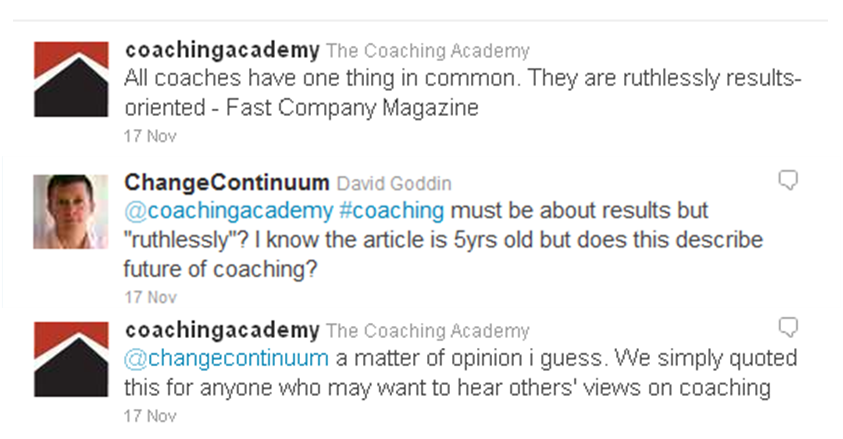
So what if I described to you someone who was "ruthlessly results-oriented"?  I recently exchanged tweets with @coachingacademy as follows:
A bit more research and I found the referenced Fast Company article Wanna be a player?  Get a coach!” written by Claire Tristram in 2006.  The actual passage in the article states:

If coaches have one thing in common, it's that they are ruthlessly results-oriented”.

I disagree.  Completely.

A question of Trust
In coaching, the basis of a successful coaching relationship is trust.  With trust established, a skilled coach can create the right degrees of tension and challenge to raise awareness and help facilitate change.  Without change there are no meaningful results.  Without results, coaching has no value.  Results come from trust.

This perhaps defines what good coaches have in common.

Ruthless means to act in a manner which is cruel, merciless or hard-hearted, without pity or compassion.

To me this feels like the antithesis of good coaching.  It feels like it could undermine trust.  It feels like it could drive a client to follow the coaches agenda, not the clients own.

A problem from the past
The article was written 5 years ago and is after all just one article.  There is an increasingly better understanding of coaching and what good practice looks like, especially when working with Executives.  We’ve moved on right?  Well this is where I have the problem…

Try Googling "ruthlessly results-oriented” and you initially get 8,330 results!  Scroll through them and it comes down to 259 results.  Over 40% of these are postings from the last year all of which seem to reference and endorse this phrase used in Fast Company magazine 5 years ago.

So what I take from this is that there are plenty of people out there who still feel that “If coaches have one thing in common, it's that they are ruthlessly results-oriented”.  Most of these people seem to be coaches…

Does it matter?
Those who know me well enough know that I’m passionate about assuring quality practice in both coaching and mentoring.  It’s one of the reasons I’m involved as a volunteer with the EMCC.

The basis for coaching is trust.  The value of coaching is in the results we help our clients achieve.

My concern is not with an article written 5 years ago.  My concern is with the continued use of language which harks back to an era when some coaches were more interested in their own results rather than their clients.  This worries me.  Deeply.

So that's my view but how about you?  Tell me what you think...

  • How would you feel about a coach who was “ruthlessly results-oriented”?
  • What are your concerns about poor coaching practice?