Wednesday, 23 November 2011

It's a Wonderful Life

By National Telefilm Associates (Screenshot of the movie) [Public domain], via Wikimedia Commons

Each Christmas Eve we watch “It’s a Wonderful Life”.  Wonderfully sentimental & full of humanity, it’s a classic film and seems to be a great reflective way to start Christmas and be appreciative for what we have.

The other morning, there was an interview on the radio with Karolyn Grimes who played little “Zuzu” - I think she might be the only surviving cast member from this 1946 film.

Wisdom at work
In the interview, she described how she learnt on the film-set from people like of James Stewart & Frank Capra that it’s OK to make mistakes.  As a 5/6 year old child actress, I think such support and teaching must have had a profound & lasting influence on Karolyn.

She also touched upon the moral outlook of the banker “George Bailey” in the film played by James Stewart.  Karolyn shared these core observations about his character:
  • He cares about the people working and helping the bank to survive
  • He has a heart & a system of ethics
What caught my attention here was a sense of wisdom which has been passed down and has endured despite Karolyn's remarkable & tragic life.  For me I think the following quote from her captures this well:

"There have been adverse things happen in my own life, but there are balances out there. And the movie itself has affected my life so much because I have George Bailey's philosophy … that friendships and caring and loving will carry you through anything ... I really feel like Zuzu is kind of a mission maybe, I don't know. I think that there is a higher power at work and that I had to go through a lot of adverse situations in my life to understand other people's pain."

Wisdom & work
I’m taking a few things from this which I think we can reflect upon in our work:
  1. Our employees, supporters & clients are our true fans.  Care deeply for them and they will reciprocate, sometimes in quite amazing ways.
  2. We are all challenged at some time during our lives.  In adversity, it’s not our commercial acumen that drives our survival it’s our friendship, our caring & our love.  It might sound “soft” but on personal reflection these factors have always been significant for me.
  3. A system of ethics drives our behaviours.  Our true fans probably recognise them already in our actions.  Perhaps we should do more to recognise them ourselves and state them explicitly. 

I think the sentiment here is best described by the angel "Clarence" at the end of the film.  He has left "George Bailey" a copy of the book Tom Sawyer and in it the message reads :

"Dear George: Remember no man is a failure who has friends.
Thanks for the wings! Love Clarence."

Monday, 21 November 2011

Ruthlessly Results-Oriented


What ideas or reactions does the word RUTHLESS concoct for you?  It probably evokes feelings of someone who would trample over you or others to achieve their goal.

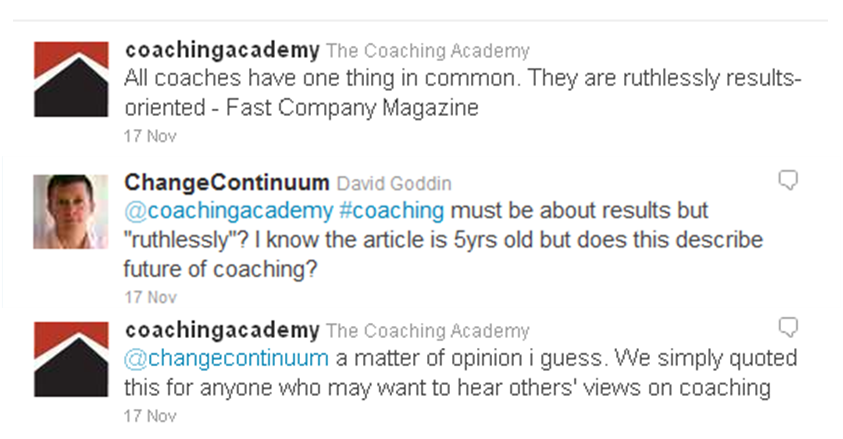
So what if I described to you someone who was "ruthlessly results-oriented"?  I recently exchanged tweets with @coachingacademy as follows:
A bit more research and I found the referenced Fast Company article Wanna be a player?  Get a coach!” written by Claire Tristram in 2006.  The actual passage in the article states:

If coaches have one thing in common, it's that they are ruthlessly results-oriented”.

I disagree.  Completely.

A question of Trust
In coaching, the basis of a successful coaching relationship is trust.  With trust established, a skilled coach can create the right degrees of tension and challenge to raise awareness and help facilitate change.  Without change there are no meaningful results.  Without results, coaching has no value.  Results come from trust.

This perhaps defines what good coaches have in common.

Ruthless means to act in a manner which is cruel, merciless or hard-hearted, without pity or compassion.

To me this feels like the antithesis of good coaching.  It feels like it could undermine trust.  It feels like it could drive a client to follow the coaches agenda, not the clients own.

A problem from the past
The article was written 5 years ago and is after all just one article.  There is an increasingly better understanding of coaching and what good practice looks like, especially when working with Executives.  We’ve moved on right?  Well this is where I have the problem…

Try Googling "ruthlessly results-oriented” and you initially get 8,330 results!  Scroll through them and it comes down to 259 results.  Over 40% of these are postings from the last year all of which seem to reference and endorse this phrase used in Fast Company magazine 5 years ago.

So what I take from this is that there are plenty of people out there who still feel that “If coaches have one thing in common, it's that they are ruthlessly results-oriented”.  Most of these people seem to be coaches…

Does it matter?
Those who know me well enough know that I’m passionate about assuring quality practice in both coaching and mentoring.  It’s one of the reasons I’m involved as a volunteer with the EMCC.

The basis for coaching is trust.  The value of coaching is in the results we help our clients achieve.

My concern is not with an article written 5 years ago.  My concern is with the continued use of language which harks back to an era when some coaches were more interested in their own results rather than their clients.  This worries me.  Deeply.

So that's my view but how about you?  Tell me what you think...

  • How would you feel about a coach who was “ruthlessly results-oriented”?
  • What are your concerns about poor coaching practice?

Thursday, 20 October 2011

It’s all about community


In the past week I’ve attended 2 great professional gatherings - the EMCC London Network & the ConnectingHR Unconference.

Although quite different in overall focus, both have challenged the conventions of most professional networks by following 4 simple principles :
  • Volunteer led
  • The community itself creates the agenda
  • The community networks to learn and develop
  • Inclusive regardless of professional affiliations or experience
What I’m struck by is the level & quality of engagement such principles creates :
  • Communities that welcome and support everyone involved.
  • Loads of really great content and ideas shared and discussed.
  • Great debate about real issues being experienced by business.
  • No grandstanding or ego.  No sales pitches.  No sponsors looking for a financial return.

Isn’t this what we all want from a professional network or conference?  Makes you wonder why we go to all the trouble and expense of some of the more expensive corporate conferences doesn’t it...

Perhaps putting community centre stage is more important to professional development than most organisations realise.  What do you think?

Stuck in the Playground?


I know many of us are trying to get our heads around social media.  However, I think that to a great extent whatever you do in this space is a reflection of who you are now and how you choose to behave in real life.


Recently I’ve seen a few posts on Twitter either openly maligning people or shouting out unfollows.  These have ranged from the curious “Did you press the wrong button?” (yeah, right!) to the outright aggressive or rude.  @naturalgrump also wrote an excellent blog recently on his experiences of rudeness - “Some people are just rude”.

Are you Stuck in the Playground?
Those of us who want to behave like adults, probably take the mature & respectful approach.  Where there is no relationship forming or we are just not interested in what is being said then we probably unfollow, disconnect, walk away.  It’s not personal, just rational.  Sometimes we make mistakes but we try to learn, develop and improve.

On the other hand, if you think social media is about being king of the playground then the mature approach won’t be attractive will it? You’ll probably want to accumulate the most connections or followers; shout out as loudly as you can so that only you can be heard; and even pick on those who don’t follow you. You’re still stuck in the playground, desperately trying to be king of the castle.  Feels like a lonely place to me...

Find your meaning
The word social comes from the latin socius, generally meaning sharing, associated, allied, partner, comrade, associate, ally.  This is how I aspire to engage – in life and with social media.  Abuse, rudeness and playground antics will never feature.

How about you?

Wednesday, 12 October 2011

Unpublished


I wrote a blog that I’m particularly proud of.  It was from the heart.  It was in response to prejudice & ignorance.  I had hoped it might educate.

I think the people who know me professionally would have appreciated it.  Those who know me personally would have seen me & my life in all of the words.

It will never be published.  The reason is that someone who matters to me asked me not to.

I had discussed it with them first and I’m ever so glad that they appreciated what I had written.  In asking for their opinion, I had implicitly agreed to respect their wishes if they didn't want it published.  It was an unspoken commitment for me to keep.

So what?
I have plenty of blog drafts (don’t we all?) but this one was different...

The process of writing that unpublished blog was cathartic.  My frustration with the ignorant will dissipate.  Sometimes we need to find therapeutic ways of dealing with such things.

That blog had an audience of 1 and the best feedback I will ever have.  The joy of blogging for me is in the sharing of yourself and the conversation it creates not the number of people who read it.

When we ask for opinion or feedback we create spoken & unspoken commitments.  We ignore these at our peril and detriment.  Respecting and keeping to those commitments build stronger relationships.

Would love to hear your stories of the unpublished, the therapeutic and the  unspoken commitments we create with our blogs.

Friday, 30 September 2011

Guide me to Success - a lesson from Essex

There’s a show on TV called “Educating Essex”.  Through 65 rigged cameras placed around a secondary school we follow the daily trials & tribulations of both children and staff.  Sounds like another trashy reality show but in fact it shows brilliantly the dynamics present in school.  As TV always does, it probably focuses on the extremes but even 20 years after leaving school I can recognise it’s familiarity instantly.

This post isn’t about the TV show but about a fundamental belief expressed by the schools Deputy Head.  It was in the context of poor behaviour and how we view punishment of children.  My interpretation of his comments are :

Children are meant to make mistakes and it should be expected.  However, we must never punish them as though they were adults otherwise we may as well make them adults at the age of 11.

Most of us can look at children or young teenagers and see their immaturities and lack of experience.  It’s not a deficiency, it’s to be expected.  Many adults & elders see it as their responsibility to help guide and support the development of children and young people.

So what happens in the workplace?

Employment contracts & company policy don’t generally accommodate any lack of maturity or experience.  The focus is often on competency or consequence, not the learning journey there or even beyond.  Any failure has a tendency to be viewed as a deficiency.

Can you imagine your children attending a school that operated in this vein?

For new managers or supervisors there is possibly a first line management course on offer.  It’s a start but we all know the figures on traditional classroom training...  Even then the focus can be on “tick-box” competency.

Where I see development really take off is where a more experienced manager provides the support and guiding hand akin to a great teacher.

They guide the “student” on their journey.   They even see it as their responsibility to help support their development.  Where mistakes are made, it’s recognised in the context of their maturity and experience.  Learning from the experience is the focus rather than punishment for failure.

Call it a mentor, a teacher, a guide or even a critical friend.  The name doesn’t matter.  What matters is that we create awareness in a way that supports development and encourages change.

Perhaps this requires a rethink of both the employment contract and the psychological contracts in place at work...

What do you think?  Would love to hear your views & experiences.

Related Posts
I can highly recommend reading these related posts from @DougShaw1 on success, failure and the environment we can create:


Tuesday, 27 September 2011

Great! Now I have guilt!

This time 8 years ago we came on holiday to Norfolk with our then 2 year son.  The holiday was wonderful but one of our biggest & fondest memories was going to Roys of Wroxham and buying him Buzz Lightyear & Woody toys.  Over the years, as in the stories, they’ve been loved & played with and passed down to our second son.

Now, the reality is that they’ve been stuck down the bottom of a box of fluffy toys for the past year or so. Ever present but largely ignored.  I’m afraid lego, Star Wars and a myriad of other toys have replaced them somewhat.

Last weekend we had a spontaneous “tidy up” of our sons bedrooms.  In parent talk, “tidy up” is a euphemism for clear out the detritus and fill a box for the charity shop so we can actually vacuum the floor.  You can see where this is going…

Everything was going great.  The kids were watching TV and I was going great guns in the youngests bedroom.  In our house, the loft is where we put those toys that we’re not quite sure whether to pass on yet.  They aren’t getting played with but maybe they’ll come back down for a 2nd lease of life.  I’d already moved a few things up there including Buzz & Woody.

I knew it was a marginal decision but I wasn’t kicking them out of the house.  In fact, I thought they may stay with us for a future generation.  When I told my wife what I'd done her face dropped - wrong decision.  I was quickly scuttled back up to the loft to retrieve both Buzz & Woody and put them back in the bedroom!

No harm had been done & we’d worked out the best thing to do, albeit driven by emotional attachment towards two inanimate outgrown toys!  No-one else knew what nearly happened.

The thing is now I have guilt, just like Rex in the original Toy story film...


I think the dialogue between Slinky and Rex is probably what my wife and I experienced!

How about you?  What are your stories of kids, toys and emotional attachments?  Does anyone else “manage out” the outgrown toys?  Would love to hear from you!

Monday, 26 September 2011

Pants


I don’t usually walk the dog in the evenings but it had been a frantic Monday afternoon and we both needed to get out.  The town was quiet and we walked down past the Abbey to the river.  Across the railway line, three teenagers were hanging out on the old platform – the only life it would see until the weekend.  We turned down the river bank and I let Basil off to hunt the river bank.  Sheer joy for him – hunting and water!

The night was closing in - it was that funny quarter-light where you know it won’t be long before you can’t see the path ahead of you.  So we turned back, Basil quite happily hunting back the way we’d come.

I’d not realised it until I’d passed him but Basil had dashed into the river and retrieved something.  I had no idea what but in he came obediently.  Now our small town is well known (somewhat ironically) for its ducks so I was preparing to dispatch something half dead...

He dropped this unknown object and it disappeared in the grass.  Odd.  No discernable shape or mark could be seen where he dropped it.  Looking closer I could see something small lying very flat on the grass.  I picked it up and realised he’d managed to perfectly retrieve a pair of mens pants. 

4 years of training.  Blood, lots of sweat and plenty of tears.  You might be forgiven that it wasn’t his finest hour…  However, finding those pants in the river in very little light with (let’s assume) no scent and then retrieving them almost perfectly.  I think we’ve come a long way!  He was very proud and in a certain kind of way so was I.


Has anything unexpected happened to you recently?  Any training successes stories?  Would love to hear them.

Thursday, 22 September 2011

Change


Tonight I attended another great talk by Marie de Guzman & Damon Newman from The Mangrove Neuroscience Consultancy.  A packed out CMI audience in central London was representative of the high interest there is in the market for understanding change at the individual level.

Marie in her talk raised three observations about change which I think are critical for business leaders and those involved in managing change:

Change Failure
The Economist Intelligence Unit reported earlier this year that “on average only 56% of change initiatives are successful”.  This report was based on responses from 288 senior executives, over 75% of which came from organisations with revenue of greater that US$1bn.  These are big players and they are saying that nearly half of their change initiatives fail. You can read the report in detail here.

Historically, I’ve heard figures of 70% being the working number for failed change programs.

What it tells us is that for all the process and investment organisations make, they are not very good at executing change and realising the intended success.

Change Blindness
Before you go any further, take 5-6 minutes or so to watch this video from the BBC “Brain Story” programme.
Isn’t it amazing that 75% of people in the experiment with the switched guy(s) didn’t notice anything!  Marie describes this blindness as extremely relevant in the Change context.  When you’ve got your head down managing change, you are not looking around.  Awareness of your environment is low.  However, awareness is key to managing and leading successful change.

Successful Change Leaders
I’ve mentioned this before and I’ll be writing about Change Leaders in detail soon.  In the research Mangrove have been doing, there is a marked difference in the attitudes and behaviours of successful Change Leaders for example :
  • They pick up more signals from their environment.
  • They are more aware and actively seek to stay aware of what is happening around them.
  • They have the energy for change.
  • They learn through failure – in fact they expect it as part of the learning process.  @DougShaw1 wrote a brilliant piece on this recently here.

My view
For a long time I’ve seen Change initiatives run as you would a technical programme or project.  Yet, for all the project discipline and milestone tracking there is a real tendency to ignore the people for the sake of the process.  My view is that this is why many programmes fail.  It’s also why Change initiatives need both Change Managers as well as Change Leaders.

Most importantly, they need Change Managers and Change Leaders with the right behaviours and competencies to make change happen.  That's change at the people level not just the process level.

Where do you see change succeed or fail?  Would love to hear your experiences & observations.

A Thorny Issue


I’ve become a big fan of blogs.  Anyone who visits here will know how often I blog, how I do it and what I talk about.  I also enjoy reading other peoples blogs and when possible I like share my comments on what the author has made me think about.

Yet I’m struck by how I find blogging simultaneously therapeutic & frustrating as well as rewarding & disappointing.  There.  I’ve fessed up!  Let me explain the background a little...

Summer was quiet on the blogging front.  It felt that plenty of others were similarly distracted with other things or just waiting until everyone was back at work.  Yet I found myself often thinking about what was happening around me and could I blog about it.  What would I say?  How would I frame it? The unanswered questions I was struggling with.  The things I didn’t fully understand yet.

What I kept coming back to was my attraction to and support of blogging versus the emotional rollercoaster it was subjecting me to.  What was going on?  Did I have the wrong attitude?  Was the issue mine alone?  It’s a thorny issue but one that I want to explore here.

Why Blog?
I’ve deliberately not trawled the web looking for research or opinion on why people blog.  It’s not that I’m not interested - it's just not a question that I want answered by supposed "gurus".  The question behind the question is actually why do I blog?  What are my expectations?  What am I hoping to achieve?

So far, I think there are only 3 reasons to go to the effort of blogging :

Commercial
You want to market yourself or your thought leadership and support your business efforts or standing as an expert.  You may be a consultant or a charity.  The end result you want to achieve is a mixture between engagement and promotion.

Altruistic
You have a lot to say and a lot to give.  Your thinking and writing is useful to others, valued even.  The end result is the giving of knowledge or opinion, not what you get back from it in terms of business or maybe even response.

Exploration
You want to share what you are thinking & experiencing with a view to learning more.  The process of writing the blog itself might be the exploration & the learning.  Sometimes the learning might come from the feedback you receive.  You might be an employee in an organisation, unemployed or even running a business – it doesn’t matter.

I’ve come to the view that people never blog just because they like writing.  If it was the joy of writing alone they would do it in a manner that was less conspicuous...  wouldn’t they?

I also think that if your blog is for Commercial or Altruistic reasons then there is certainly a degree of ego at play (when is this not the case!).  You want to know that what you are writing about is valued.  Whereas if your blog is for Exploration then perhaps ego is less relevant.

Why do I Blog?
Where I’m coming to with this is an uneasy sense that perhaps my blog is unwittingly a mixture of all three and that this is the cause of the emotional rollercoaster.  I’m still not sure.

What I do know is that I need to resolve or possibly come to terms with the fact that I find blogging simultaneously therapeutic & frustrating as well as rewarding & disappointing.

What are your thoughts?  Is there a better way of looking at this?  How does blogging make you feel?  Why do you blog?  What are your expectations?  What are you hoping to achieve?

About the Photo
The tree seems to be a Kapok Tree.  The photo was taken from a hammock on holiday as I was pondering this subject.  It seemed curious that the thorns were clearly to keep away those who would do harm but allow access to those who wouldn’t cause damage.  Humans had already chipped away the defences lower down leaving the tree scarred but supposedly more approachable.  I think there's a parallel here with blogging.  Personally, I’d rather be an ant working in a system climbing to the top than be seen as a threat to be repelled or causing irreparable damage.

Tuesday, 20 September 2011

Ubiquitous


Five years ago I had a Blackberry – I hated it.  Not the technology itself but the ever present email & calendar.  With a change in jobs I quite happily left it behind and stuck with a simple mobile phone.  That didn’t work out so well in the end (long story) and everyone else already had a smartphone so I succumbed to the technology.  Now I can’t imagine trying to manage without one.

No problem?  Well I’m not so sure....

This summer we took 2 weeks in the sun to do nothing but sit by the pool, go to the beach and have fun as a family.  An utterly brilliant time was had by all.  I had to work whilst away so I brought the smartphone and netbook.  Neither were omnipresent and the fact that I had to work was remarkably OK with the family.

Sitting by the pool I could see most adults were either reading their Kindle, browsing their iPad or tapping their smartphone.  When not in the pool, most of the teenage kids were almost constantly on their own phones doing similar.  The technology was ubiquitous and for most of the day these families were happily uncommunicative with those immediately around them. 

Yet there were still families like us who were quite happy reading a good old paperbacks, playing with the kids, swimming and hanging out together.  When it got too hot or we were too tired we’d all find shade and read, play cards or Pictureka.  Sometimes the kids would go explore and hang out with friends they’d made or play table tennis.  Even when they got out their DSi’s they’d do it in the company of other kids, constantly sharing, talking and engaging.

Here’s the problem .... am I missing something?

I feel that the ubiquity of technology can be liberating and empowering.  I believe that it can also cause us to miss the engagement, connections and sheer joy of those immediately around us.

So is my "kindle-resistance" useful or a hang up from the past?

Is it OK to be uncommunicative around the pool when you can communicate with friends on the other side of the world?  After all you're still engaging.

Am I missing something?  I would love to hear your views & experiences.

Monday, 19 September 2011

The Good, The Bad & The Ugly


I recently wrote about Linked Lurkers and how we need to engage with and contribute to communities to avoid being seen as a lurker.  Discussions with @dougshaw1 and others revealed that many of us have mixed experiences of LinkedIn especially LinkedIn Groups.  I have quite strong feelings on the subject so thought I’d share them with you!


LinkedIn is often compared to a business conference or even a professional networking event.  Overall I don’t disagree, but in Discussion Groups I’ve experienced a real division in quality which you’d be unlikely to experience in the real world.

For me these are best described as The Good, The Bad & The Ugly:

The Good
In essence communities of practice that provide support, share information and offer perspectives and learning.  Often smaller in size, the experience is one of quality not quantity.  In these groups not only do you find value in much of the discussion content, you find members of the group becoming part of your professional network, friends even.

The Bad
The Group purpose might seem appealing but in fact it's very hard to find what attracted you in the first place.  Either through scale or poor management you spend a lot of time looking for something useful.  Where the membership is in the thousands, the combination of self promotion and irrelevance becomes an almost toxic mix.  There may be some nuggets in there but if this was a conference you would have walked out by now.


The Ugly
Discussion is absent & self promotion rules.  Any discussions are used as a platform for members to promote their position.  Self promotion and even shouting matches are par for the course.  If you are looking for a supplier of services then there are plenty here but would you really go to a demented hawkers market to procure expertise for your organisation?


I’ve been actively using LinkedIn since 2004 when it had a little over 1million members.  Now 7 years later it has 120m members.  To my mind the above 3 types of Discussion Group have always existed.  Maybe each serves it’s purpose.  For me I’m only interested in The Good where community matters and good things come from good behaviours.  When I feel a Group becomes irrelevant, too large or full of spam & self-promotion I leave.

What do you think?  What are your experiences?

Wednesday, 14 September 2011

Watch out there’s a Lurker about!


It was nearly 2 years ago that I was sat with some colleagues and the notion of the “LinkedIn Lurker” was raised. I’m not sure if the term was ever in common parlance but the notion of social media lurking has stuck in my mind ever since.


Then this morning the wonderful and very engaging @AlisonChisnell tweeted confessing to a bit of LinkedIn lurking. Later on @James_Mayes, @lesanto and myself got into a chat about career & business coaches lurking on Twitter or roaming networks without engaging with people.


I’m not aware of a conventional definition but for me you are lurking if you choose to observe discussions rather than participate, engage & contribute. Nothing wrong with that perhaps - we all choose to participate in a manner that suits us.

However, if LinkedIn is akin to a business conference, and Twitter is like a cocktail party, why would you bother to go to either and say nothing? To engage with no-one, only to watch. To take what you can but contribute nothing at all. You wouldn’t deliberately... in fact, if you did lurk at a conference or party people might actively avoid you!

My experience is that when you engage you build relationships and mutual respect. When you contribute you get so much more back. When you do both you grow and develop. When you do neither you are irrelevant.

What are your thoughts on social media lurking? When is it ever a valid position to hold? Would love to hear your thoughts!